


Overthinking is thinking that has stopped being useful: the same worry, decision, or conversation replayed again and again without reaching anything new. Psychologists call it rumination when it points backward (what went wrong, what I should have said) and worry when it points forward (what might go wrong). Both feel like problem-solving. Neither is. That is the whole trick of it, and it is why "just stop thinking about it" has never worked for anyone.
I want to be honest about where this article comes from. I am not a psychologist. I am someone who overthought most things for most of his life, tried a long list of remedies, from books to breathwork to shamanic ceremonies, and eventually found, through yoga and then Vipassana meditation, a way of relating to thought that actually held. What follows is what I would tell a friend: what the loop is, why it runs, and the seven things that have worked, in the order I would try them.
What Overthinking Actually Is
The useful definition is not about quantity. Thinking a lot about a decision is not overthinking; thinking in circles about it is. Rumination has three markers: it is repetitive (the same content, again), self-referential (it is about me, my mistake, my future), and unproductive (it never ends in an action or a decision, only in more of itself).
The research on this is clear and a little sobering. The psychologist Susan Nolen-Hoeksema spent decades studying rumination and found that it does not just accompany anxiety and depression; it predicts them, prolongs them, and makes them harder to treat. And a 2010 study in Science by Killingsworth and Gilbert, which sampled the thoughts of more than 2,000 people in real time through their phones, found that minds wander about 47% of waking hours, and that people were less happy when their mind was wandering than when it was on the task in front of them, whatever the task was. The wandering itself, not the content, was the cost.
What Causes Overthinking: The Root of the Loop
There is no single cause, but there is a single mechanism, and understanding it is half the cure.
The mind treats an unresolved worry as an open threat. Its job is to close threats, so it returns to the worry to "work on it". But rumination does not actually work on anything: it rehearses. Each pass through the loop produces a small stress response, which the mind reads as evidence that the threat is real, which justifies another pass. It is a fire that feeds itself.
Underneath that mechanism, three things tend to keep it fuelled. The first is a belief that overthinking is useful: that if I worry enough, I will be prepared, or that going over the mistake will stop me repeating it. (Metacognitive therapy, developed by Adrian Wells, is built almost entirely on dismantling this belief, and it works.) The second is avoidance: rumination is uncomfortable, but it is less uncomfortable than the feeling underneath it, so the mind stays in the loop to avoid the feeling. The third is simple input: a mind fed a constant stream of news, messages, and other people's opinions has more raw material to chew on and fewer gaps in which to digest it.
A note on the medical side, because people ask. Overthinking is a feature of generalised anxiety, of depression, and of ADHD, where it often takes the form of racing, branching thought rather than a single loop. If your overthinking comes with persistent low mood, panic, or an inability to focus that affects work or relationships, it is worth talking to a doctor. Everything below still applies; it just should not be the only thing you do.
Why "Just Stop Thinking" Makes It Worse
Try, for the next ten seconds, not to think of a white bear.
That experiment, run by Daniel Wegner in 1987, produced one of the most replicated findings in psychology: suppressing a thought makes it come back more often, not less. The effort of not-thinking requires monitoring for the thought, and monitoring is a form of attention, and attention is what thoughts feed on.
This is why the methods that work are never about stopping the thought. They are about changing what you do when the thought arrives. The Buddhist teachers I learned from would say: you cannot stop the birds flying over your head, but you can stop them nesting in your hair. Every technique below is a version of that.
7 Ways to Stop Overthinking That Actually Work
I have ordered these from the fastest to the most durable. The first three can be done in the middle of a meeting; the last one is a practice.
1. Name the loop
The moment you notice you are going around again, label it silently: thinking. Planning. Rehearsing. Worrying. One word, neutral tone, as if noting the weather.
This is the noting technique from Vipassana meditation, and it is the single most useful thing I have ever learned. The label does something the thought cannot survive: it converts you from participant to observer. A thought you are inside of can spin for an hour. A thought you have noted as "rehearsing" tends to lose its grip in seconds, because you are no longer feeding it with attention; you are watching it. Practised daily, this becomes automatic, and that is the point at which overthinking stops running your evenings.
2. Ask one question: "Is this solvable right now?"
Rumination and problem-solving feel identical from the inside. This question separates them. If the answer is yes, do the one next step: send the email, make the decision, write the list. If the answer is no, because it is 11 p.m., or because it depends on someone else, or because it already happened, then there is nothing to solve, and every further pass through the loop is rehearsal. Say so, out loud if you are alone: not solvable now. Then go to method 3.
3. Move attention into the body
Thoughts live in the head. The fastest exit is downward. Feel the weight of your feet on the floor. Feel the temperature of the air on your hands. Notice five things you can physically feel, four you can see, three you can hear. (This is close to the "3-3-3 rule" that circulates for anxiety: three things you see, three you hear, three body parts you move. It works for the same reason.)
The body scan is the long form of this: attention moved slowly from the toes upward, spending a few breaths in each region. It is incompatible with rumination, because attention cannot be fully in your left calf and in last Tuesday's conversation at the same time. It is also the technique I would give anyone who has never meditated and needs something tonight.
4. Write it down, once
If the same content keeps circling, it is often because the mind does not trust you to remember it. Externalise it. One page, by hand: the worry, and the next action if there is one. Then close the notebook. Writing converts a loop into a record, and a record does not need rehearsing.

There is a stronger version of this called scheduled worry time, used in cognitive-behavioural therapy: fifteen minutes a day, same time, in which you are allowed to worry as much as you like, and outside of which any worry is postponed to the slot. It sounds artificial. It is remarkably effective, because it gives the mind the reassurance that the worry will be attended to, which is what it was demanding.
5. Breathe out longer than you breathe in
Overthinking is a state of the body as much as of the mind: raised heart rate, shallow breath, tension in the jaw and shoulders. You can change the state directly. Breathe in for four, out for six or eight, for two minutes. A long exhale stimulates the vagus nerve and activates the parasympathetic "rest and digest" response, and a calmer body gives the mind less to be alarmed about. In yoga this is a form of pranayama; you do not need to call it anything.
6. Move, preferably outside, preferably without headphones
Walking, yoga, swimming, anything rhythmic that involves the whole body, reliably interrupts rumination, and the effect is stronger outdoors. Part of it is physiology; part of it is that a body in motion in a wide space gives attention somewhere large to rest. The one condition is to leave the podcast at home. The point is fewer inputs, not different ones.

7. Practise ten minutes a day, so the skill exists when you need it
Everything above is easier for people who meditate, and this is not mysticism; it is training. Ten minutes a day of sitting, watching the breath, noting thoughts as they arise and returning, builds exactly the capacity you need at 11 p.m.: to see a thought as a thought. Bedtime is the exam; the daily ten minutes is the training. If you have never meditated, our beginner's guide to starting meditation walks through posture, timing, and what to do with a wandering mind, and our article on what Vipassana meditation is explains the noting technique from the beginning.
How to Stop Overthinking at Night
Night is where overthinking does its worst work, because there is no input and no escape. Three rules that hold. Do not look at the clock; the arithmetic ("if I sleep now I get five hours") is itself a loop. Keep the phone in another room; a dimmed screen is still the most engaging object in the house. And drop the demand to sleep: reframe the next twenty minutes as rest, and start a body scan from the toes. If a thought arrives, note it (planning) and return to the body. Most people do not reach the knees. Our full guide to meditation for sleep covers five techniques for this, including what to do when you wake at 3 a.m.

Detachment from Overthinking: What Meditation Actually Changes
People sometimes hear "detachment" and imagine not caring. That is not it. What a meditation practice changes, over months, is the distance between you and your thoughts. The thought still arrives. You still notice it. But there is a gap now, a half-second in which you can see it as an event in the mind rather than as a fact about the world, and in that gap you can choose whether to follow it.
I noticed this first on my three-day retreats, long before I had any intention of teaching. Sitting in silence for hours, you watch the same worries come round and round, and at some point, without doing anything, you see them as weather: passing, impersonal, not requiring a response. That seeing does not go away when the retreat ends. It fades, and daily practice keeps it, but once you have seen a thought as a thought you cannot fully un-see it. This is the "detachment" that helps, and it is available to anyone willing to sit still for a while.
When Overthinking Needs More Than Meditation
Meditation is a strong tool and a poor substitute for treatment. If overthinking has been most days for months, if it comes with persistent low mood, panic, sleep loss, or an inability to focus, or if it is about one event you cannot move past, talk to a doctor or a therapist. Cognitive-behavioural therapy and metacognitive therapy both target rumination directly and have good evidence. Meditation works well alongside them and is often recommended by the same clinicians. It should not have to carry the whole load.
Learn It in a Room, Not from a Screen
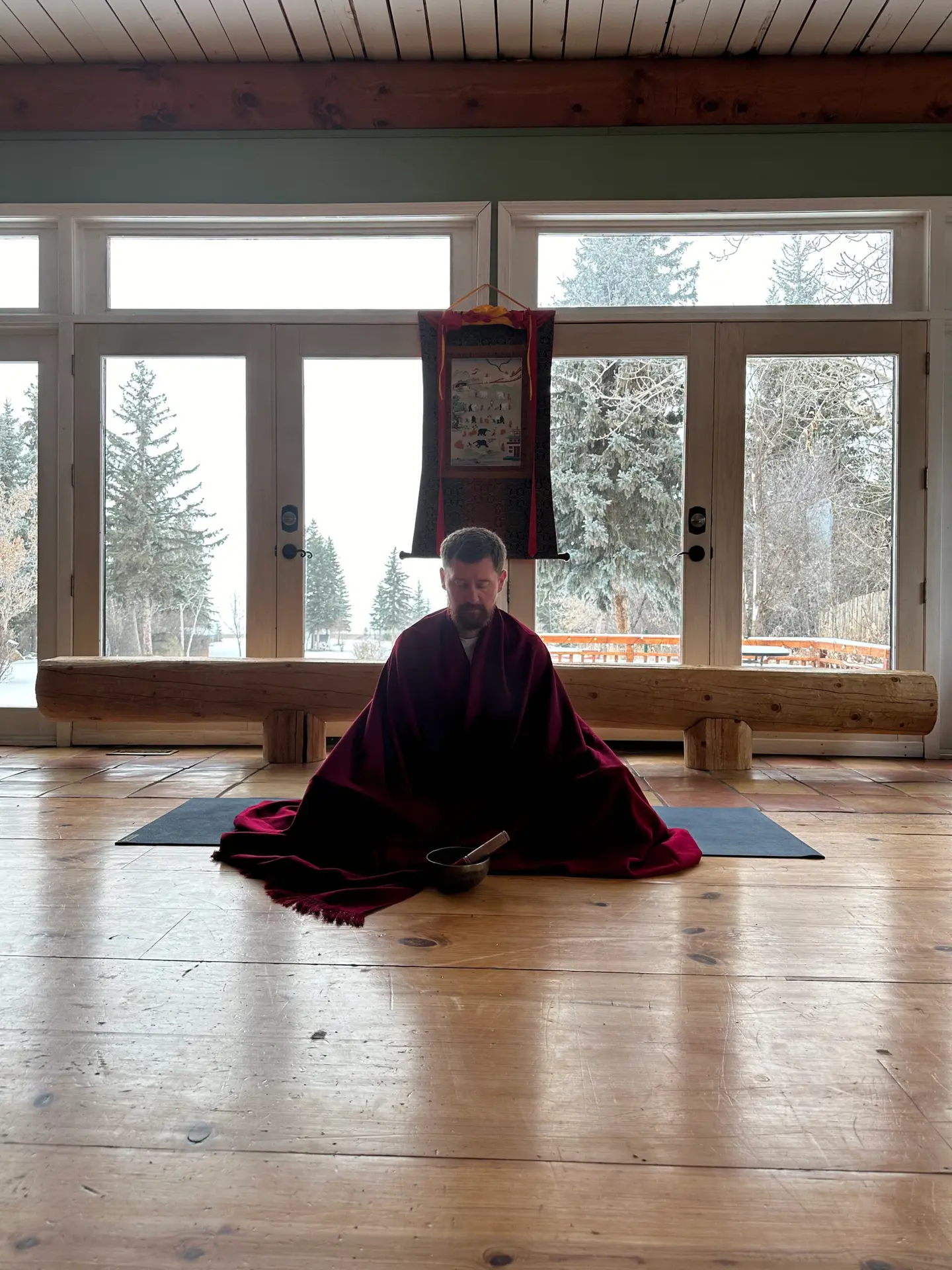
Every method here can be learned from this page. It is faster and it holds better if you learn it in silence with a teacher in the room. Our one-day retreat in Calgary and Edmonton is a single day of guided practice, and the three-day silent retreat at Mount St. Francis is where most people first experience the gap between themselves and their thoughts. That was true for me. It is usually true by the second day.
Frequently Asked Questions
How do I stop being an overthinker?
You do not stop being one by force; you change what you do when the loop starts. Name the thought ("worrying"), ask whether it is solvable now, and move attention into the body. Practised daily for a few weeks, this becomes automatic, and the loops shorten from hours to minutes. Daily meditation is what makes it stick.
What is the root cause of overthinking?
The mind treats an unresolved worry as an open threat and returns to it to "work on it", but rumination rehearses rather than solves. The loop is kept running by a belief that worrying is useful, by avoidance of the feeling underneath the worry, and by constant input. Anxiety, depression, and ADHD all make it more likely.
What is the 3-3-3 rule for anxiety?
A grounding exercise: name three things you can see, three sounds you can hear, and move three parts of your body. It works by pulling attention out of thought and into the senses, which is the same mechanism as the body scan. It is a good emergency tool, not a long-term practice.
Is overthinking a sign of ADHD?
It can be. In ADHD, overthinking often looks like racing, branching thoughts rather than a single loop, and it comes with difficulty focusing and finishing tasks. Overthinking is also common in anxiety and depression. If it affects work or relationships, an assessment is worth it; the techniques here still help, but they may not be enough on their own.
Does meditation help with overthinking?
Yes, and it is one of the best-supported uses of it. Mindfulness-based approaches reduce rumination in clinical trials, and the mechanism is direct: meditation trains you to see a thought as a thought rather than a fact. The noting technique from Vipassana is specifically designed for this. Ten minutes a day is enough to notice a difference in a few weeks.
How do I stop overthinking at night?
No clock, no phone, no demand to sleep. Start a body scan from the toes, note any thought that arrives, and return. Reframe the time as rest rather than a sleep attempt. If you are still wide awake after twenty minutes, get up, sit somewhere dim, breathe out slowly for a few minutes, and return to bed when drowsy.

Valerii Bandurko
Co-founder & retreat coordinator · Vipassana.ca
Yoga entered Valerii’s life through back pain about eight years ago; of all the practices he explored since, Vipassana is the one that stayed. He never planned to teach, but after a one-day retreat with Artem in 2024 he became a certified yoga instructor (Yoga Alliance, International Yoga Federation), and now leads the one-day retreat in Calgary and, together with Artem, the 3-day silent retreats at Gull Lake and Mount St. Francis.
- Nolen-Hoeksema S, Wisco BE, Lyubomirsky S. Rethinking Rumination. Perspectives on Psychological Science. 2008;3(5):400–424. doi:10.1111/j.1745-6924.2008.00088.x
- Killingsworth MA, Gilbert DT. A Wandering Mind Is an Unhappy Mind. Science. 2010;330(6006):932. doi:10.1126/science.1192439
- Wegner DM, Schneider DJ, Carter SR, White TL. Paradoxical effects of thought suppression. Journal of Personality and Social Psychology. 1987;53(1):5–13. doi:10.1037/0022-3514.53.1.5
- Wells A. Metacognitive Therapy for Anxiety and Depression. Guilford Press, 2009.